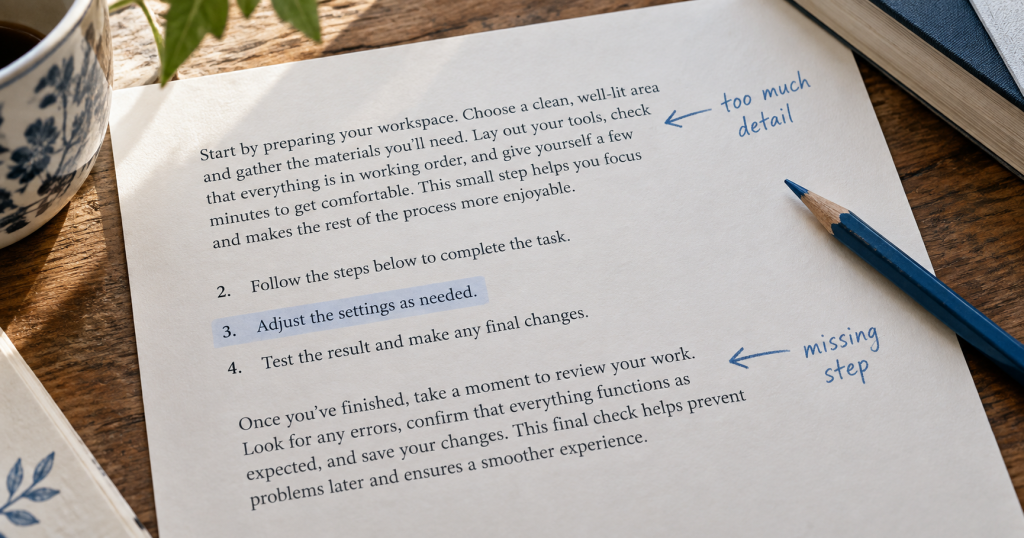
Readers can follow instructions when each step names a real action, the condition required before it, and the visible result that should exist afterward. A numbered sequence isn’t enough. The reader must be able to tell where they are and whether the step worked.
The writer usually misses these details for an understandable reason: once you know a task, several decisions collapse into one motion. The reader still has to see them.
Declare who the instructions are for
Before the first step, state the reader level and the starting condition.
For example:
These instructions are for a blogger with a complete rough draft who wants to check its internal links before publication. You should already know the post’s intended reader and have access to the final link destinations.
That short setup prevents two kinds of confusion. A true beginner knows what preparation is missing, and an experienced reader can skip explanations they don’t need.
Do not call something “beginner friendly” while silently assuming technical access, a paid tool, familiarity with specialist language, or a decision the article never helped the reader make. Name the prerequisite where the reader can see it.
Show what each step changes
A useful instruction moves the work from one condition to another:
- before: links are selected but unverified;
- action: open each final destination and confirm its title, status, and relevance;
- after: every destination is known to exist and match the promise of its anchor text.
If you can’t describe the before and after, the step may be advice rather than an instruction. “Improve your links” expresses a goal. “Open each destination and compare the page’s actual answer with the words you linked” gives the reader something to do.
This distinction also exposes missing steps. If step three assumes a verified destination but step two only selected a title, the procedure has jumped over the verification decision.
Add a checkpoint after important actions
A checkpoint answers, “What should I see now?”
Good checkpoints are observable:
- the outline now contains one outcome under every major heading;
- the image measures the required dimensions;
- the draft has no links to unpublished destinations;
- the final paragraph gives one next step rather than three competing requests.
Avoid checkpoints such as “make sure it looks good” or “confirm everything is optimized.” Those phrases move the uncertainty back to the reader.
The need for a checkpoint is especially strong when the result isn’t visually obvious. A button click, save action, or status change may appear successful while the underlying object remains unchanged. Tell the reader what to refetch, reopen, or compare.
Put decisions inside the procedure
Many instructions fail because they describe clicks but omit judgment.
Suppose the step says, “Add an internal link.” The reader still needs to decide:
- which question remains unresolved;
- which published page answers it;
- which sentence earns the link;
- what anchor text describes the destination;
- whether the link works after saving.
Those aren’t optional explanations around the procedure. They are the procedure. The practical method in internal linking for small blogs starts with the reader’s next question because the mechanical act of inserting a link cannot choose a useful destination.
Explain what to do when a step fails
The reader should know what to do when the expected result doesn’t appear. You don’t need to predict every problem, but explain the most likely one that would stop them from continuing.
Use this shape:
If you see ___, continue to the next step. If you see ___ instead, return to ___ and check ___ before trying again.
For an editorial procedure:
If the next section answers the question raised by the previous one, write the smallest bridge and continue. If it answers a different question, move or remove the section before adding transition copy.
That branch protects the reader from repeating an action that cannot work in the current state.
Test the instructions without filling gaps from memory
Read the procedure as if you don’t know what the writer meant.
For every step, underline:
- the object being changed;
- the action taken;
- the result expected;
- the check that confirms the result.
Then look for implied nouns and verbs. “Configure it correctly” hides both the object and the decision. “Review the settings” does not say what to compare. “Continue as normal” assumes a shared normal that may not exist.
If the opening has not yet told the reader what outcome the procedure creates, use an answer-first introduction before expanding the steps. The reader should know the destination before being asked to follow the route.
Show how the reader can tell the task is finished
The final instruction should let the reader recognize that the task is done. State what is now true, what remains outside the procedure, and what the next logical action is if one is required.
Followable instructions do more than arrange actions in order. They reveal the decisions between those actions, show the reader what progress looks like, and provide a way to recover when the expected state does not appear.