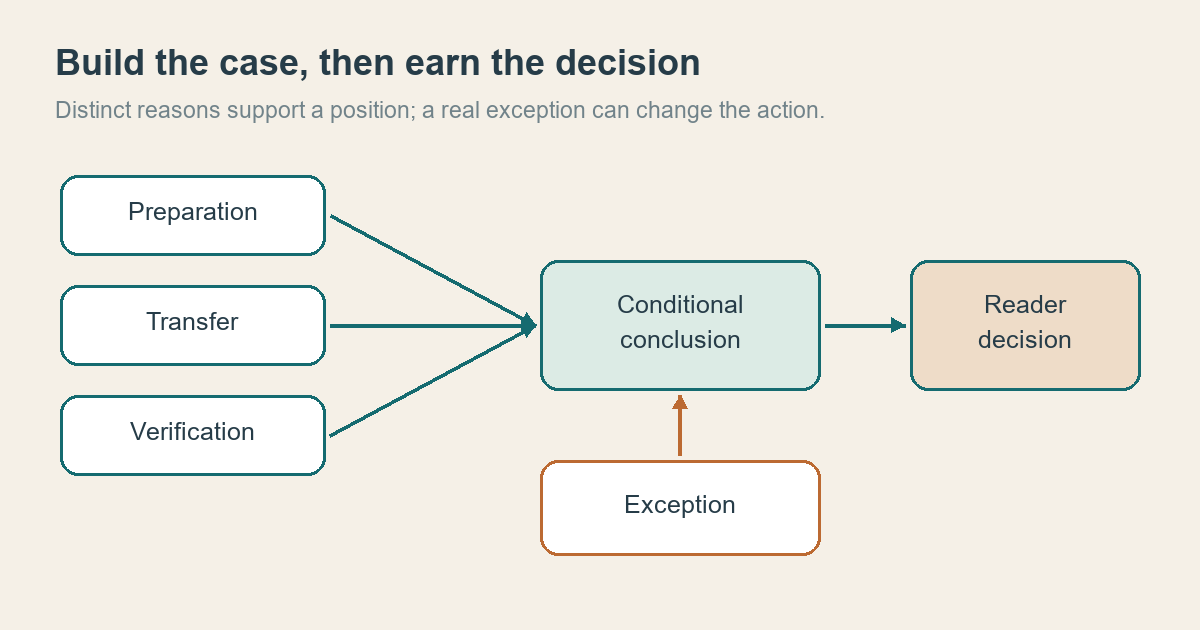
Build a blog post argument by making a clear, supportable point and showing the reader why it holds up. Start with a position you can defend, explain the connection between each reason and that position, and give a serious exception enough space to change the advice when it should.
If you've collected plenty of useful notes but the draft still feels like a pile of information, more research may not solve the problem. The missing part can be your judgment: what these facts mean together and what the reader should do because of them.
I'd work on that connection before polishing the sentences. Otherwise, you can end up with polished notes that still don't add up to an explanation.
Give the position a condition
"Planning is important" is too broad to organize much of anything. A reader can agree with it and still have no idea how to plan the next post.
Try a position that makes a decision possible. Here's an invented example: "When you're writing a tutorial for a beginner, test the steps yourself before spending time on the introduction."
Now there's something to examine. Why test first? Because missing prerequisites can change what the tutorial needs to explain. Why before the introduction? Because you may discover that the task has a different starting point than you assumed. Does this apply when you're discussing a general principle rather than giving a procedure? Not necessarily.
The condition makes the argument more useful, and it gives you a way to avoid claiming that one writing order belongs to every article. Treat your first position as provisional. If the sources or a fair objection change what you can defend, change the position before asking the reader to accept it.
Write your position in one sentence. Include who it applies to and the situation where it helps. If you can't do that yet, use the process for turning a messy idea into a post you can finish before building a case around it.
Make each reason do different work
A reason should explain something the reader needs to believe or understand before your conclusion makes sense. Three ways of saying "this saves time" aren't three supporting reasons.
For the tutorial example, the case might develop like this:
- Testing reveals missing prerequisites, so you can tell the reader what they need before starting.
- Recording the actual sequence helps you separate necessary steps from habits that only apply to your setup.
- Observing the result gives you a checkpoint the reader can use to tell whether the process worked.
Those reasons support the same position, but each contributes something different. One concerns preparation, another concerns transfer to a different situation, and another concerns verification.
Don't leave the reader to work out why those facts belong together. After each reason, explain how it supports your recommendation. "The process has prerequisites" doesn't explain why you should test before writing the opening. You need to make that relationship visible.
You don't need a fixed number of reasons. Keep the ones that substantiate the position, explain a necessary mechanism, or help the reader make the decision. If removing a passage would make the recommendation harder to understand or less defensible, that passage may belong even when it's a secondary point.
Separate support from illustration
An example can make your reasoning easier to see, but an invented example can't establish that a result occurred. The tutorial above demonstrates a possible decision process. It doesn't prove that testing first always makes articles faster to write.
Before attaching a source, ask what it supports. Does it establish the fact you're using? Does it apply to the situation you've named? Does your conclusion go further than the source?
You can also offer editorial judgment without disguising it as research. "I'd test the procedure first because a missing prerequisite can change the whole explanation" is a reasoned recommendation. A claim that this order cuts writing time in half would require evidence you don't have in this example.
For source handling, the guide to citing sources without losing your voice shows how to let evidence support your explanation instead of replacing it.
Let the objection affect the recommendation
Take the strongest fair objection. Someone might say, "I already know the procedure. Repeating it would waste time."
That deserves an answer. If the procedure is simple, stable, and recently verified in the same conditions, a complete new trial may add little. You could check the uncertain steps instead. If it depends on permissions, versions, or materials you haven't checked, familiarity isn't enough to promise that the reader can follow it.
The objection narrows the advice. It doesn't require abandoning the central position, and it doesn't need to become an unrelated debate about every writing method.
You're showing the reader which conditions matter, including the ones that make your preferred approach less useful.
Read the reasons back toward the conclusion
Make a short record of the draft's actual argument: position, reason, connection, support, exception, and resulting action. Use what's on the page, not what you intended to write. For the tutorial example, one note might be: "Reason: testing reveals missing prerequisites. Connection: those prerequisites change what the introduction must tell the reader. Exception: a recent verified record may let me check only the uncertain steps." You can now see whether the draft actually makes each connection.
If a reason doesn't connect, add the missing explanation or remove it. If an exception changes the answer, carry that change into the conclusion. If the support is weak, narrow the claim rather than making the wording more confident.
Then finish with the decision the case earned. In the tutorial example, the reader should know whether to run a full trial, check uncertain steps, or proceed from a recent verified record. "Planning matters" would throw away the useful distinction you just built.
Put your recommendation next to the reasons you've written. If a reader would have to supply a missing connection to reach it, write that connection before calling the argument finished.